
Announcement
Published: 19 March, 2026
Established researchers lead teams, win grants, shape disciplines and supervise the next generation of scholars. They are among the most experienced and productive people in our universities. They are also, consistently, the group least well served by formal development support.
Today, the White Rose University Consortium is changing that.
The Established Researchers Hub launches today as the sector’s first dedicated resource of its kind, freely available to researchers at the Universities of Leeds, Sheffield, and York and to anyone across higher education.
What the hub offers
The hub brings together three types of content. Curated resources are organised by persona and topic, so researchers can find what is most relevant to their situation and needs. Peer discussion guides offer a structured way for small groups of colleagues to explore common challenges together, without the need for an expert facilitator. And a collection of career stories presents honest, grounded reflections from established researchers on the decisions they made, the trade-offs they navigated, and what they would tell their younger selves. These are not polished success narratives. They are the kind of frank, practical perspectives that researchers told us they rarely find.
At the heart of the hub are five researcher personas developed through the project. The Juggler captures a shared experience described by almost every researcher the team spoke with: holding multiple responsibilities, identities and expectations all at once, with limited space to think or plan. Built around that foundation are four distinct personas reflecting different research leadership models: the Lab Builder, the Independent Scholar, the Project Architect, and the Boundary Spanner. Researchers are invited to find themselves in the personas and navigate from there.
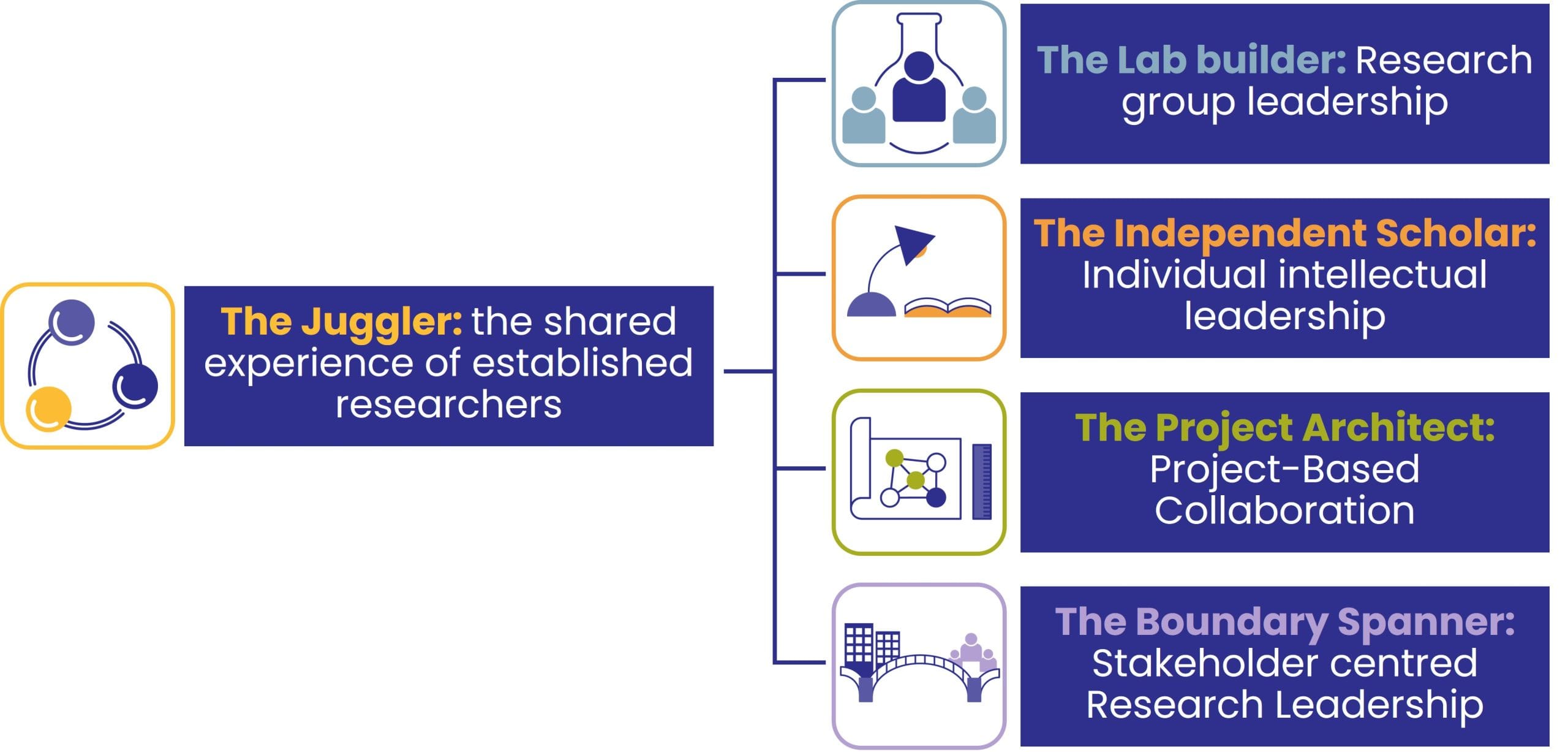
Resources for the Juggler and the Lab Builder are available from today. Resources for the Independent Scholar, the Project Architect, and the Boundary Spanner will follow over the coming months.
Built on original research
The hub has been built in direct response to original research led by Monica Morris, Steve Joy, and Tracey Stead, conducted in collaboration with the Established Researcher Forum at the University of Sheffield. That research drew on 27 in-depth interviews, two focus groups, and a cross-institutional review of existing provision, involving established researchers from all three White Rose universities across a wide range of disciplines and career stages.
Its central finding was that established researchers occupy what the project describes as a “squeezed middle”. They manage substantial research programmes, lead teams, teach, and contribute to institutional life. Yet they are often navigating complex career transitions without the tailored support available at other career stages. The project identified eight interconnected development themes and confirmed three as immediate priorities: strategic career development, research leadership, and workload and personal effectiveness.
Karen Hinxman, Head of the White Rose University Consortium, said:
“This work shines a light on a group of colleagues who make an enormous contribution to research and to our universities, yet whose development needs are often overlooked. We are committed to supporting established researchers so they can continue to thrive, lead, and make the discoveries and advances that shape our future.”
What comes next
The hub launches today as a growing resource. Resources for the remaining three personas will be added over the coming months, alongside further content through spring and summer 2026. An in-person programme for established researchers, built directly from the personas and resources, is also in development.
Explore the Established Researchers Hub
Tell us what you think by emailing info@whiterose.ac.uk
Related news
See all news
Announcement

Share experiences and exchange solutions: Join the cross-institutional PRISM Coffee & Chat Scheme
Are you managing research projects and looking to connect with others in similar roles? Managing large, post-award research...
Announcement
Supporting researchers returning from parental leave: Shaping the next 18 months
Across our partner institutions, an average of 200 research staff take an extended period of parental leave each year. We...
Announcement

Prosper: Funded career development opportunity for postdocs
Applications are open for the next cohort of our Prosper programme. Specifically designed for postdocs ready to take...
Announcement

White Rose Equity in Leadership Programme named winner at Yorkshire Excellence in HR Awards
The White Rose University Consortium, a strategic partnership between the Universities of Leeds, Sheffield and York, won the...
Sign up to our newsletter
The White Rose University Consortium actively engages with institutional, regional and national partners to propel positive change and create sustained impact for individuals, communities, and the region.


