
Personas
A central feature of the resource collection is a set of established researcher personas.
Through interviews and focus groups across our partner universities, we identified that established researchers do not experience their roles in the same way. A set of personas emerged from patterns in the research and from wider experience of working with researchers across the sector. They reflect different ways people experience their research careers, rather than fixed roles or labels.
The personas are intended as tools for reflection. They can help you:
- recognise aspects of your own experience
- consider how your priorities and pressures may have shifted over time
- explore resources that are particularly relevant to how you work and lead
Resources can be filtered by persona, and we will continue to develop curated materials aligned to each persona over time.
"The personas present archetypes of established researchers and the kinds of challenges they face and advice they would give to their earlier selves, together with useful resources and stories. It's just so important to reflect the breadth of academic careers and the diversity in the journeys that people can take and make these visible." - Dr Marina Cantarutti, Research and Innovation Associate at the University of York
Introducing the personas
When we analysed the data, we identified a shared experience that almost every participant described, regardless of discipline or seniority. We call this shared experience The Juggler.
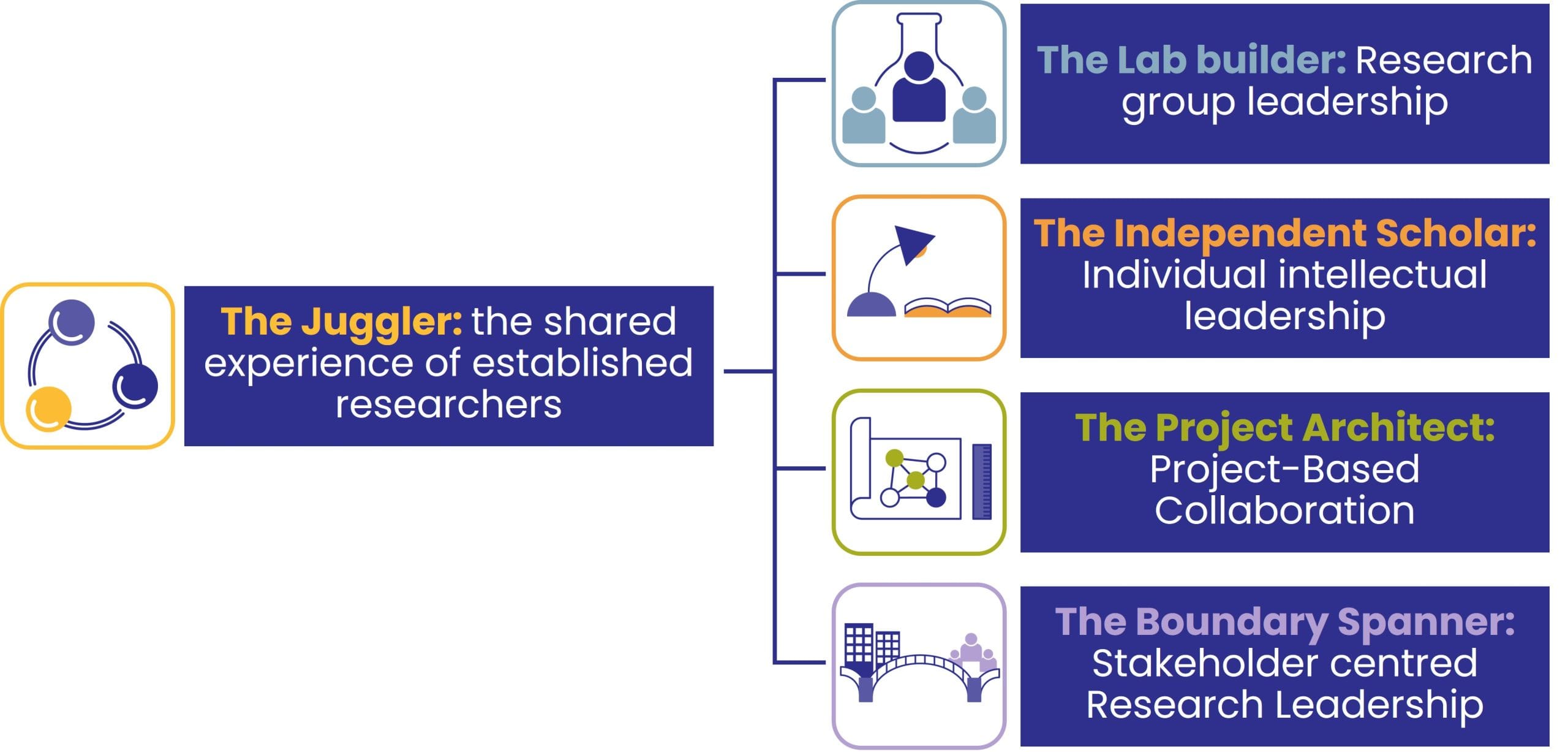

The Juggler
“I am holding more than one role, expectation, and identity at once.”
The Juggler represents the shared experience described by almost every established researcher we spoke to.
Established researchers often feel stretched across multiple responsibilities - research, teaching, leadership, supervision, administration, engagement - with limited clarity about what should take priority. Time is fragmented. Thinking space is squeezed. Expectations shift.
Common worries
- Constant time pressure and cognitive overload
- Unclear or inconsistent promotion signals
- Difficulty protecting focused thinking time
What support helps
- Practical career planning frameworks
- Tools for prioritisation and strategic decision-making
- Peer support and validation from others at a similar stage
The Juggler is not a type of researcher - it is a condition of being established in today’s university environment. Most researchers will recognise themselves here.
Beyond the shared experience of the Juggler, we identified four distinct ways researchers organise and experience their leadership.
Most people will primarily identify with one of these personas - alongside elements of The Juggler.

The Lab Builder
“My research lives in my team, my lab, and the systems that keep everything running.”
The Lab Builder leads a complex research ecosystem. Their impact depends on sustaining and scaling teams, infrastructure, budgets and people.
Their work blends intellectual leadership with operational management.
Common worries
- Keeping the whole system running without burnout
- Leadership and management work going unseen
- Risks to continuity when funding or people change
What support helps
- Strategic delegation and team design
- Workload negotiation that reflects leadership complexity
- Promotion narratives that capture scale, responsibility and risk

The Independent Scholar
“My impact comes from sustained thinking and writing, but the system fragments my time.”
The Independent Scholar’s leadership is grounded in intellectual influence. Their reputation grows through books, articles and sustained scholarly contribution.
Their challenge is not capability - it is protecting time and agency in a system which divides their attention.
Common worries
- Eroded writing momentum
- Undervaluation of intellectual leadership
- Informal leadership roles without recognition
What support helps
- Negotiating and protecting writing time
- Support to sustain delivery once time is created
- Clear promotion criteria that value intellectual influence

The Project Architect
“I assemble people, disciplines and timelines, knowing each success is temporary.”
The Project Architect thrives in time-limited, grant-funded environments. They bring together collaborators, manage complexity and deliver ambitious research within shifting funding landscapes.
Their leadership is adaptive and deeply relational - shaped by the ebb and flow of funding cycles.
Common worries
- Career fragmentation across successive projects
- High responsibility within time-limited structures
- Difficulty evidencing project-based leadership in promotion cases
What support helps
- Strategic grant portfolio planning
- Decision-making frameworks for choosing opportunities
- Tools to build coherence across projects

The Boundary Spanner
“Engagement is not an add-on. It is the centre of my research career.”
The Boundary Spanner works at the interface between academia and external partners - policy, industry, communities or practice.
For them, engagement is core research work, not a supplementary activity.
Common worries
- Competing stakeholder expectations
- Impact work not fully recognised internally
- Relational and emotional labour going unseen
What support helps
- Recognition frameworks for engagement leadership
- Boundary-setting and workload negotiation
- Institutional sponsorship and advocacy
Related events

White Rose Equity in Leadership – Information Session (online)

Day 1 of 3: White Rose Equity in Leadership Programme

Day 2 of 3: White Rose Equity in Leadership Programme

Day 3 of 3: White Rose Equity in Leadership Programme
Read more:


