
Announcement
Published: 9 December, 2025
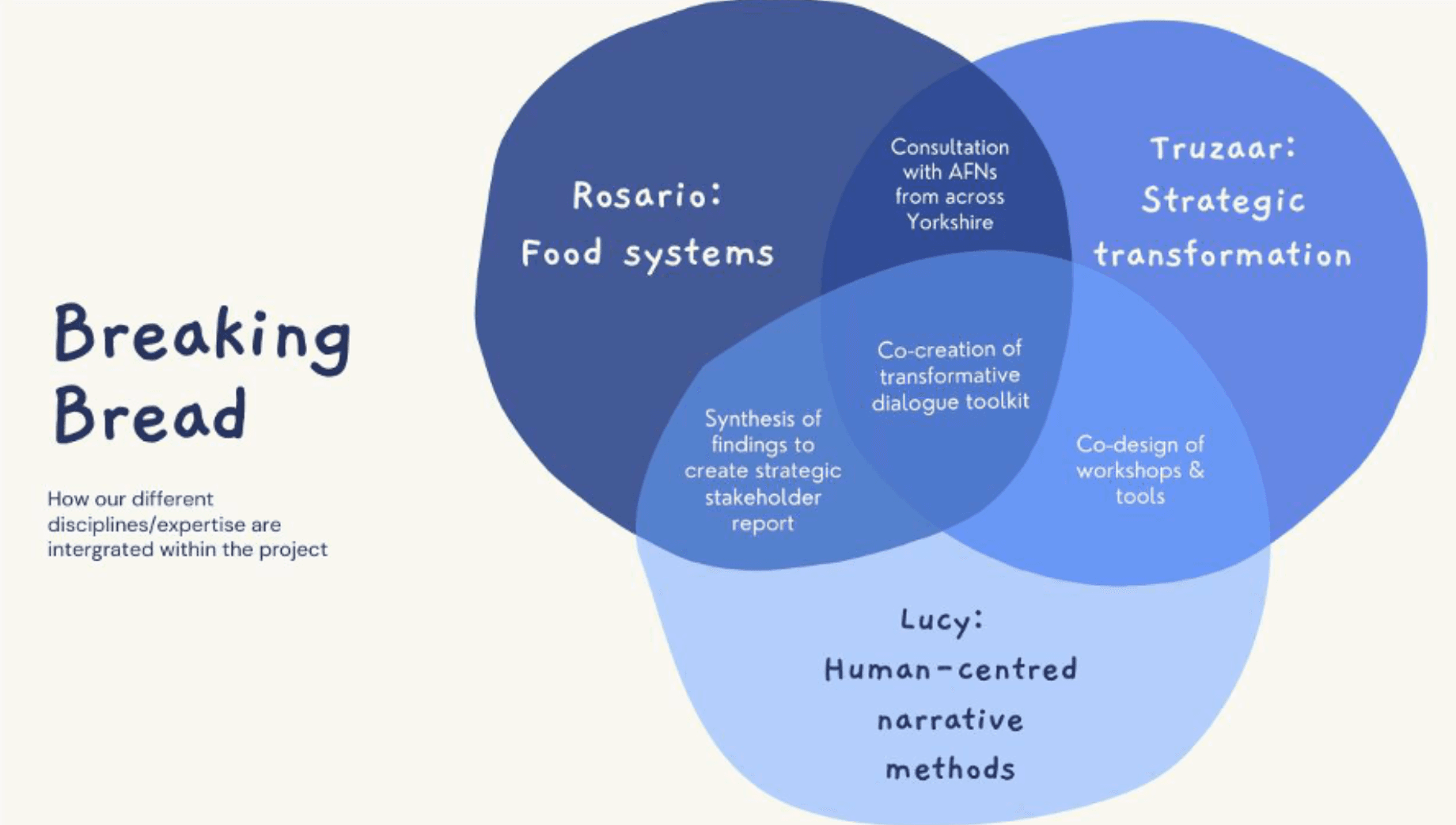
The White Rose University Consortium has announced the second of its 2025 Crucible Seed Fund awards, supporting a new interdisciplinary project exploring the human stories behind Yorkshire’s Alternative Food Networks (AFNs). The project – “Breaking Bread: A Narrative Analysis of Resilience and Transition in Yorkshire’s Alternative Food Networks” – brings together early-career academics Dr Lucy Prodgers (Leeds), Dr Truzaar Dordi (York), and Dr Rosario Michel-Villarreal (Leeds), who met through this year’s Crucible Programme.
What began as a conversation during the residential labs quickly revealed a shared research ambition: to elevate the voices and lived experiences that shape sustainable food systems, and to understand how those human stories influence resilience and long-term transition.
A Crucible collaboration rooted in shared curiosity

Dr Lucy Prodgers
Lucy arrived at Crucible focused on developing new methods for understanding lived experiences of illness through narrative and the arts. “I’ll be honest – I knew nothing about food systems! But hearing Rosario and Truzaar talk about resilience and transitions sparked something: what if we could bring those human stories into strategic planning? That mix of disciplines felt exciting and necessary.”
For Truzaar, Crucible created a rare opportunity to connect the strategic with the human.
“The White Rose Crucible Programme pushes you to find connections where none seem to exist. My research typically focuses on macro-level sustainability transitions, which often risk treating people as abstract data points. What we need for sustainability transformation is to bridge the gap between high-level planning and the messy, authentic reality of lived human experience. Working with Lucy and Rosario provided the missing pieces – combining narrative depth and food systems expertise to turn theoretical ambition into practical reality.”
Why human stories matter in Alternative Food Networks
AFNs represent producers, community groups, cooperatives, and local supply-chain innovators who prioritise sustainability and social value. Yet many analyses of food systems focus on economic data or technical efficiencies — missing the rich identities, motivations, and experiences that shape resilience. Lucy highlights why this matters:
“Systems change starts with people. These networks are full of embodied experiences, identities, and relationships. Capturing those stories through arts-based approaches makes the invisible visible and helps shape strategies that feel grounded.”

Dr Rosario Michel-Villarreal
Rosario adds “AFNs are full of people who care deeply about food, community, and place, but their everyday experiences often go unheard.”
Dordi agrees, “We often analyze food systems through cold economic metrics, but AFNs run on passion, values, and community connection — ‘invisible’ assets that traditional models fail to value. These human stories are essential to diagnose the real challenges these networks face and understand what gives them the capacity to endure and adapt to an inherently uncertain future.”
Arts-based workshops to co-create Yorkshire’s food futures
The 12-month project funded by the White Rose Crucible Seed Fund will use creative, participatory and narrative methods to explore how AFN practitioners understand resilience and envision future pathways. Working closely with local artists, the team will first design a suite of creative prompts and materials to help participants reflect deeply on their experiences.
They will then bring together around 20 practitioners for a co-creative workshop in Leeds, using storytelling to uncover shared challenges, values and aspirations across the network. Finally, the insights generated through this process will be translated into a public-facing Transformative Dialogue Toolkit and showcased at a cross-sector stakeholder event, ensuring that the stories and perspectives gathered can drive meaningful, community-informed action.
Connecting lived experience to long-term strategy
The team’s methodological innovation lies in combining dialogical narrative analysis with the Three Horizons Framework — a foresight tool used to map long-term system transitions. By merging personal stories with strategic models, the researchers hope to reshape how sustainability planning is done in practice.
Lucy explains:
“I hope it shows the power of listening deeply. By turning lived experience into something policymakers and communities can use, we can make change feel human. And for research, I’d love this to open doors for more creative, narrative-led approaches to sustainability.”

Dr Truzaar Dordi
For Truzaar, the project marks a turning point: “My hope is that ‘Breaking Bread’ fundamentally expands how we approach long-term strategic planning. By integrating arts-based methods with the ‘Three Horizons’ framework, we aim to shift the focus of transitions research from a purely intellectual exercise to one that engages both the head and the heart — ensuring that our pathways to the future are driven by lived experience, not just abstract data.”
Laying the Foundations for Future Collaboration
Reflecting the Crucible Programme’s emphasis on long-term networks, Breaking Bread is designed not as a standalone project but as the beginning of a new collaborative research agenda. The team plans to use the pilot data to prepare a major future funding bid, deepening their work on sustainability transitions, participatory research, and community-led systems change.
Rosario adds “I hope Breaking Bread gives Yorkshire’s food networks a space to reflect, share experiences, and shape stronger futures together. I hope we can show why human-centred insights should sit alongside technical evidence when designing food and resilience strategies.”
As a 2025 Crucible Seed Fund award, Breaking Bread demonstrates how interdisciplinary thinking — and the relationships forged through Crucible — can generate research with genuine social impact.
Related news
See all news
Announcement
Attend the free White Rose Resilience Network workshop: What makes networks resilient to damage?
This project is a direct result of the White Rose Crucible Seed Fund, an initiative designed to help...
Announcement

Align HE: Full conference agenda and programme now available
We are very happy to introduce the final conference agenda and programme for Advancing Leadership and Inclusion for...
Announcement

Share experiences and exchange solutions: Join the cross-institutional PRISM Coffee & Chat Scheme
Are you managing research projects and looking to connect with others in similar roles? Managing large, post-award research...
Announcement
Supporting researchers returning from parental leave: Shaping the next 18 months
Across our partner institutions, an average of 200 research staff take an extended period of parental leave each year. We...
Sign up to our newsletter
The White Rose University Consortium actively engages with institutional, regional and national partners to propel positive change and create sustained impact for individuals, communities, and the region.


