
At an established career stage, work rarely comes in neat, single-track projects.
Most established researchers are holding multiple strands at once: long-running research programmes, teaching and supervision, leadership or departmental roles, external commitments, and opportunities that arrive mid-cycle. These strands sit on different timescales, are owned by different people, and often come with expectations that are only partly explicit.
Individually, each strand may feel manageable. Collectively, they can create a persistent sense of overload, uncertainty, or even stress and anxiety.
One experienced academic described their solution simply: “Every year or so, I need to see everything in one place.”
Their approach was deliberately practical. They started by mapping all current and anticipated tasks and activities on a single large whiteboard, often beginning with a loose mind map. The map would soon reveal themes or work strands.
For each strand, they identified the person who ultimately defined success (not necessarily themselves!). This might be a programme director, head of department, collaborator, or mentor. Naming this authority helped replace assumptions that could lead to overwhelm with conversations.
Each strand was then built out to include:
- rough timelines and milestones
- outputs and their expected scale or quality
- meetings and preparation time
- dependencies, contacts, and resources
They also added a final layer: purpose. Why does this matter? What does it contribute to career progression, learning, values, or future narratives?
What emerged resembled a Work Breakdown Structure, typically used in project planning (for more information, see here). However, this time, it wasn’t a rigid project plan, but a thinking tool. Seeing it in this way helped the academic gain a sense of scale and the ability to influence, which replaced their panic and overwhelm.
Unknowns and gaps were highlighted. Instead of absorbing uncertainty internally, the academic used these to identify a small number of focused questions and booked short conversations with the named authority to clarify expectations. Rather than assuming what was required in those conversations anything unclear could be replaced with an agreed and negotiated expectation.
Once mapped, the structure could be used to sense-check capacity, negotiate scope or timing, populate diaries or Gantt charts, and make more confident yes/no decisions.
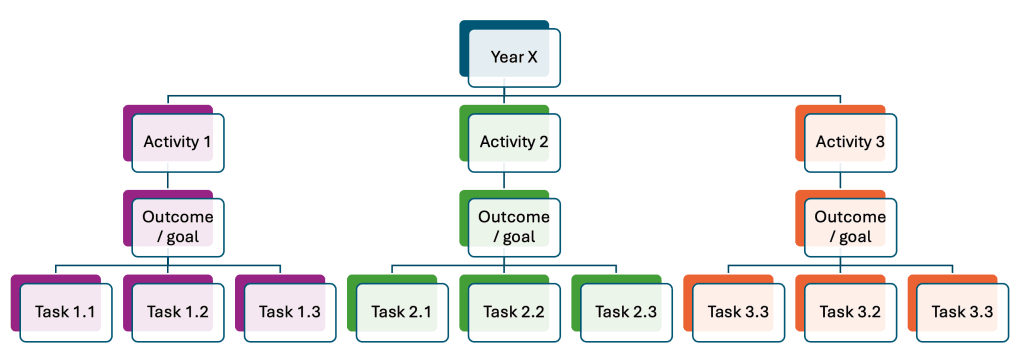
It might also be sensible to build in a provisional or “TBC” strand. This is not an empty gap, but a conscious allocation of capacity for future opportunities that are likely to arise. Pair this with clear criteria, for example that the opportunity must add to a narrative CV, stretch intellectually, or genuinely energise. This allows new requests to be assessed against an explicit map, rather than squeezed in by default.
If you’d like to try this approach yourself, download our worksheet of prompts to create your own version of a Work Breakdown Structure. This will help you see the whole picture, supporting better decisions, conversations, and trade-offs over time.
Once you’ve done this, a good next step is to plot it out on a timeline. See the resource on creating a Gantt chart.
What will you take forward?
One thing to try: What becomes clearer when you see all your commitments in one place, and which one assumption will you seek clarity on straight away?
Related Resouces
See all Established Researcher resources
Learn from research exemplars: lab management practices
Learn what effective PIs actually do day to day to support good research practice, integrity and rigour.
Leadership in a time of jeopardy: realism about promotion, leverage and the realities of academic middle management
Be strategic with your time investment – set triaging criteria
Set simple rules to make it easier to decide what to say yes or no to.
Review and enhance your recruitment practices
Make better hiring decisions that enable your research strategy and set your research group up for long-term success.
Sign up to our newsletter
The White Rose University Consortium actively engages with institutional, regional and national partners to propel positive change and create sustained impact for individuals, communities, and the region.


