
Blogpost
Published: 17 September, 2026
Keeping Equity, Diversity, and Inclusion (EDI) rooted in human connection rather than bureaucratic compliance is a shared priority across our three partner universities.
As part of National Inclusion Week 2026, we reflect on Valuing Voices, a digital initiative co-developed by an international partnership between colleagues at the University of York and Mahidol University, funded by The Wellcome Trust Institutional Funding for Research Culture (IFRC).
Designed as an open-access digital tool, Valuing Voices offers a practical framework to help researchers and research-enablers design, deliver, and implement research projects across disciplines with equity, global transparency, and social responsibility at their core.
Rather than viewing inclusion or social responsibility as an administrative hurdle, Valuing Voices re-imagines project design as a collaborative, reflective process that strengthens interdisciplinary research quality and expands real-world impact.
Hear from the Valuing Voices project team members as they reflect on its success so far.
This interview is presented as a benchmark to encourage cross-institutional reflection, knowledge sharing, and collective support for staff-led inclusion.
Our advice is to start small. Just take a look at the Valuing Voices tool, perhaps pick one principle that speaks to you and see what you can do with it.
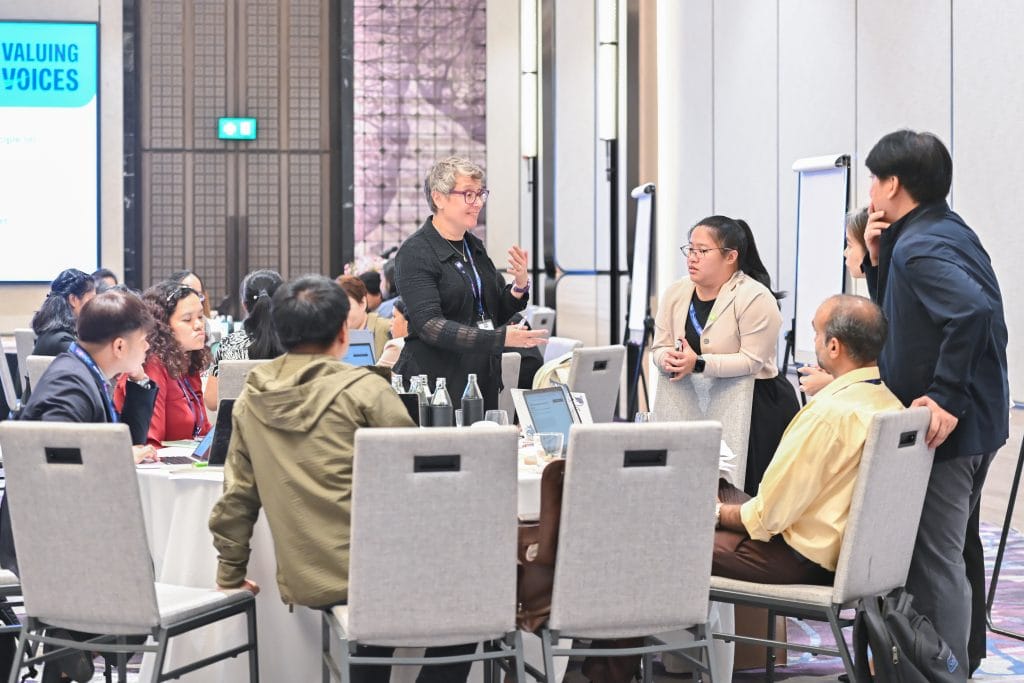
Valuing Voices Workshop in Bangkok
How does Valuing Voices help researchers move past ‘paperwork’ to create genuine, lived equity in their projects?
“The tool is designed to be something you begin to engage with in the planning stages of a project, writing in practical steps you wish to implement in your practice. This therefore creates a working document that you can regularly return to in order to review whether you’re following through on the equitable and responsible ways of working you’d committed to. By writing these practices into grant applications, you’re highlighting your commitment to reflective research practice that focuses on making the equitable choices in day-to-day delivery” says Roisin Blackburn, Senior Project Officer at Valuing Voices.
“The resources we have curated are all aimed at the practical application of equitable and responsible research, rather than theorising abstract concepts. We have checklists, top tips, case studies and reflective questions to cut through the ‘paperwork’ and help researchers move to action”, says Lucy Cheseldine, Training and Resource Development Officer.
Valuing Voices centres on five core areas from equity in teams to strategic risk mapping and sustainability. Which of these areas do teams usually struggle with most, and how does the tool guide them through it?
“Surprisingly, strategic risk mapping has been a major challenge for researchers. While it might seem straightforward, risks in research are complex and can often masquerade as worries. Our guidance and resources encourage researchers to reframe their worries as risks and to share them with their team, who can then help to monitor and mitigate them throughout a project. Researchers must realise the risks posed to themselves in this process, whether that’s by the sensitive research they are doing or the environment they are working in. Our ultimate goal is to produce a research culture where researchers think together about risks from the very start, being informed and planning for the worst – while hoping for the best!” says Lucy Cheseldine, Training and Resource Development Officer.
Major research funders are increasingly demanding robust Responsible Research and Innovation (RRI) metrics. How have academics used the tool’s planning metrics to strengthen their grant proposals?
“We’ve seen successful grant funding from researchers from a range of career stages and roles, which really demonstrates how the principles are supportive to the whole research community rather than a select few. For example, Professor Oliver Craig, Deputy Head of Department at University of York, engaged with the online tool when writing his European Research Council (ERC) application earlier this year. Oliver recognised how ERC projects are so often orientated around the Principal Investigator, but the tool made him ‘think differently about the team and put in place some measures to ensure the benefits of the project are likely to be shared more equitably’. Oliver heavily drew on the Valuing Voices principles in his ERC interview, and successfully received the £1 million grant which will involve applying the principles in practice. This case is particularly useful to highlight how the tool can support even established researchers to think differently about how they approach equitable practice,” says Roisin Blackburn.
As colleagues across different fields have adopted Valuing Voices, what has surprised you most about how research teams and research-enablers respond to results-based planning?
“We have learned that the results-based planning questions in our tool are great conversation starters. They encourage research (support) teams to imagine, for example, what equity and diversity would look like in their team, and then work out what needs to be done to achieve this. In some workshops, group discussions began before we’d even finished explaining the task. While in others, groups would ignore coffee breaks to keep working on their answers!” says Karen Glerum – Brooks, Training and Resource Development Officer.
What is one practical step a research team or research-enabler can take today using Valuing Voices to make their upcoming projects more transparent and socially responsible?
“Our advice is to start small. Just take a look at the Valuing Voices tool, perhaps pick one principle that speaks to you and see what you can do with it. During the project, we worked as a Living Lab doing just that: we explored how we could apply the principles to our own work. For example, when we needed to promote the beta version of our website to gather feedback from users, we printed the QR code on a handout impregnated with flower seeds. Our only intention with this was to honour the principle of Environmental Sustainability by giving the paper a second use. But to our own surprise, the seed paper added considerable value as a conversation starter about our principles and a way to keep people engaged with the project. They even shared pictures of their flowers with us!” says Karen Glerum – Brooks, Training and Resource Development Officer.
Valuing Voices has developed an open-access tool, freely available to the global research community. It is also available on the White Rose Established Researchers Hub.
Visit the Valuing Voices tool to access curated resources, planning questions, and case studies.
Related news
See all news
Blogpost

Supporting researchers returning from parental leave: Cross-institutional workshop insights
Across the partnership, around 200 research staff take extended parental leave each year. This is a critical career...
Blogpost

How Sheffield’s staff networks are building an inclusive university from the inside out
Across our three partner universities, we all face the same core challenge of keeping Equality, Diversity, and Inclusion...
Blogpost

How to make the most of a PhD Careers Fair
Across our three partner universities, Leeds, Sheffield, and York, doctoral researchers share a common challenge: transitioning high-level academic...
Blogpost

Reimagining research culture through anti-ableism: An interview with Sheffield’s WAARC team
In many sectors, conversations around Equality, Diversity, and Inclusion (EDI) are common, but often the specific challenges and...
Sign up to our newsletter
The White Rose University Consortium actively engages with institutional, regional and national partners to propel positive change and create sustained impact for individuals, communities, and the region.


