
Article
Published: 20 January, 2026
This month Professor Charlie Jeffery, Vice Chancellor of the University of York, concludes his term as Chair of the White Rose University Consortium Board. Professor Shearer West, Vice Chancellor of the University of Leeds, will take on the role, leading the group which oversees governance of the Consortium.
We spoke to both Charlie and Shearer about the leadership transition and what comes next for White Rose. First, Charlie shares his perspective on the Consortium’s progress and its role in the HE landscape.
Reflecting on your time as Chair of the White Rose University Consortium Board, which milestones or initiatives do you feel best illustrate the Consortium’s impact and progress under your tenure?
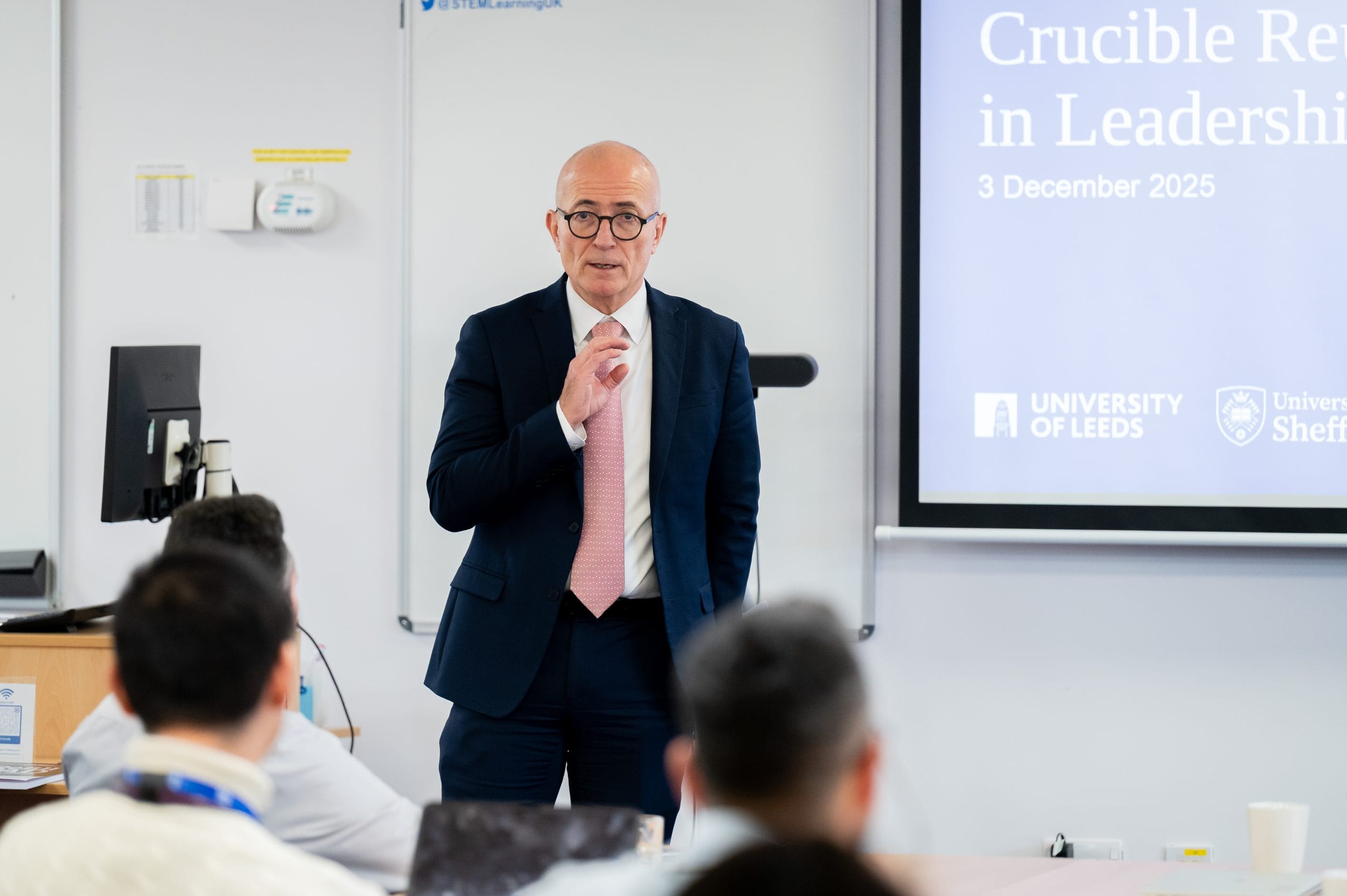
Professor Charlie Jeffery speaking at the 2025 White Rose Celebration
Firstly, we are now close to having a coherent set of collaborative development activities that support academic researchers throughout their careers – from PhD through to senior leadership. There is still work to do: filling a gap in mid-career development, and considering how (and whether) to extend the portfolio further to teaching-focused academics and professional services staff. But the commitment to collaboration in professional development across three like-minded universities is unique, and hugely valuable in underpinning the shared labour market across Yorkshire – to our collective benefit.
Secondly, the Equity in Leadership programme. It offers developmental support, but crucially also creates a wider peer network for colleagues from ethnic minority backgrounds who are considering steps into senior leadership roles in both academic and professional services contexts. None of us yet has a senior leadership cadre that reflects the diversity of our society, and that limits us as institutions. Equity in Leadership is an important step towards making this right.
White Rose has a strong regional focus across Yorkshire. Why is that important to you, and how do you think it helps create real career opportunities and pathways for people in the region?
The key point is that we share a labour market. Many colleagues move between Leeds, Sheffield and York without having to relocate, and that’s a significant advantage for all three institutions. White Rose is a shared investment in that advantage – helping to anchor talented people in the region and create sustainable career pathways across Yorkshire.
In a sector under increasing financial and structural pressure, what role do you believe collaborations like White Rose play in strengthening the future of higher education?
We face both financial pressures to collaborate and clear encouragement from government to do so. There is a strong logic to specialising in areas of greatest strength, reducing duplication, and working together to connect those specialisms.
White Rose is a strong example of this in practice. By sharing investment in collaborative professional development, we avoid duplication and spend less in aggregate than if we each acted alone. Just as importantly, we build relationships that pay back over time – through peer networks that foster deeper collaboration, connect complementary expertise, and help us scale up research ambitions. That puts us in a stronger position to compete for the larger research awards that UKRI increasingly envisages.
As you hand over the Chair’s role, what do you hope White Rose will prioritise over the coming years?
Let’s hope we can get that ‘cradle to grave’ – why not from PhD to Vice Chancellor? Portfolio completed!
With a clear sense of what White Rose has achieved under Charlie’s leadership, attention now turns to the future. As she prepares to take on the role of Board Chair, Professor Shearer West shares her priorities for the Consortium and how she hopes to build on its collaborative foundations in the years ahead.
As you prepare to take on the role of Board Chair, what will be your first priorities for White Rose, and where do you see the biggest opportunities ahead?
I feel that I am stepping into this role at a point of real strength for White Rose. Under Charlie’s leadership, the Consortium has built a distinctive and highly valued portfolio of people-focused activity, with a clear commitment to collaboration, equity and long-term career development.
My first priorities will be to build on that foundation by increasing engagement and visibility across our three universities, ensuring that colleagues at all career stages – academic and professional services alike – understand what White Rose offers and how it can support them. That includes strengthening evaluation, so we can clearly demonstrate impact, and continuing to invest in initiatives that support diverse career pathways and help retain talented staff within Yorkshire.
How do you plan to build on White Rose’s collaborative foundations to drive meaningful, long-term change across the partner universities?
One of White Rose’s greatest strengths is the depth of trust and collaboration that already exists among the partner universities. My aim is to nurture that further by supporting stronger cross-institutional networks and a deeper sense of belonging to Yorkshire’s higher education community.
We know there are areas where individual institutions lack critical mass or resource, and White Rose is ideally placed to address those gaps through shared, strategic solutions. By continuing to focus on people – their development, progression and connections – we can drive long-term change that benefits individuals, institutions and the region as a whole.
I am looking forward to building on what Charlie and the Board have achieved, and to help position White Rose as a sector leader in collaborative people development over the years ahead.
Related news
See all news
Article

Sheffield launches its new Research Culture Action Plan
The University of Sheffield has unveiled its new Research Culture Action Plan, following approval by its University Executive...
Article

York hosts transformative Equity in Leadership programme
In a significant step towards fostering diversity and inclusion in higher education leadership, the University of York is...
Article

White Rose programmes unite for celebration of collaboration and achievement
The University of York hosted colleagues from across the White Rose University Consortium this week for a special...
Article

New Initiative to Enhance Inclusivity in UK’s EPMS Sectors
A new initiative, EDI Hub+, has been launched to bolster inclusivity within the UK’s engineering, physical, and mathematical...
Sign up to our newsletter
The White Rose University Consortium actively engages with institutional, regional and national partners to propel positive change and create sustained impact for individuals, communities, and the region.


